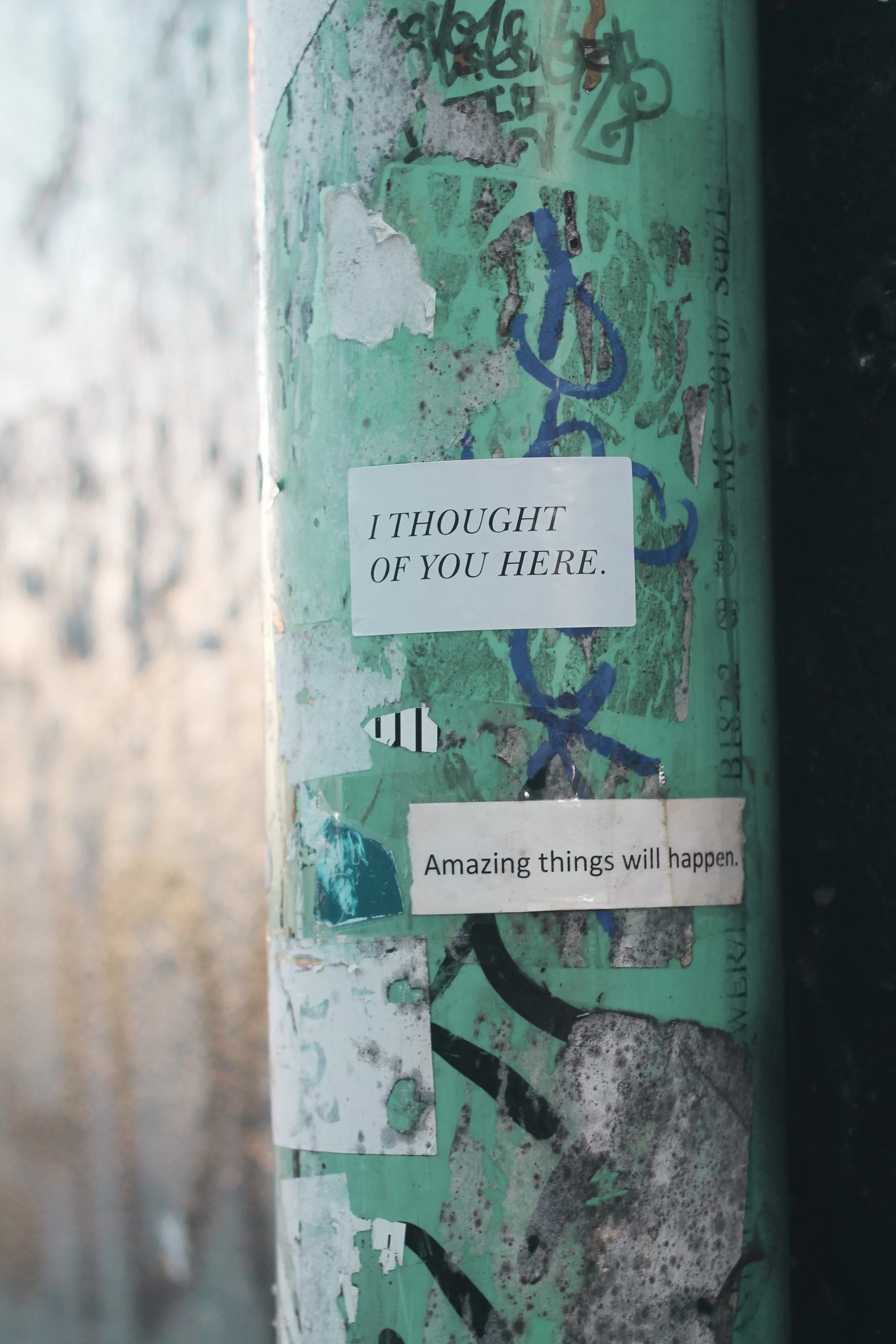
I Thought Of You Here, And So Loss Has Not Erased You
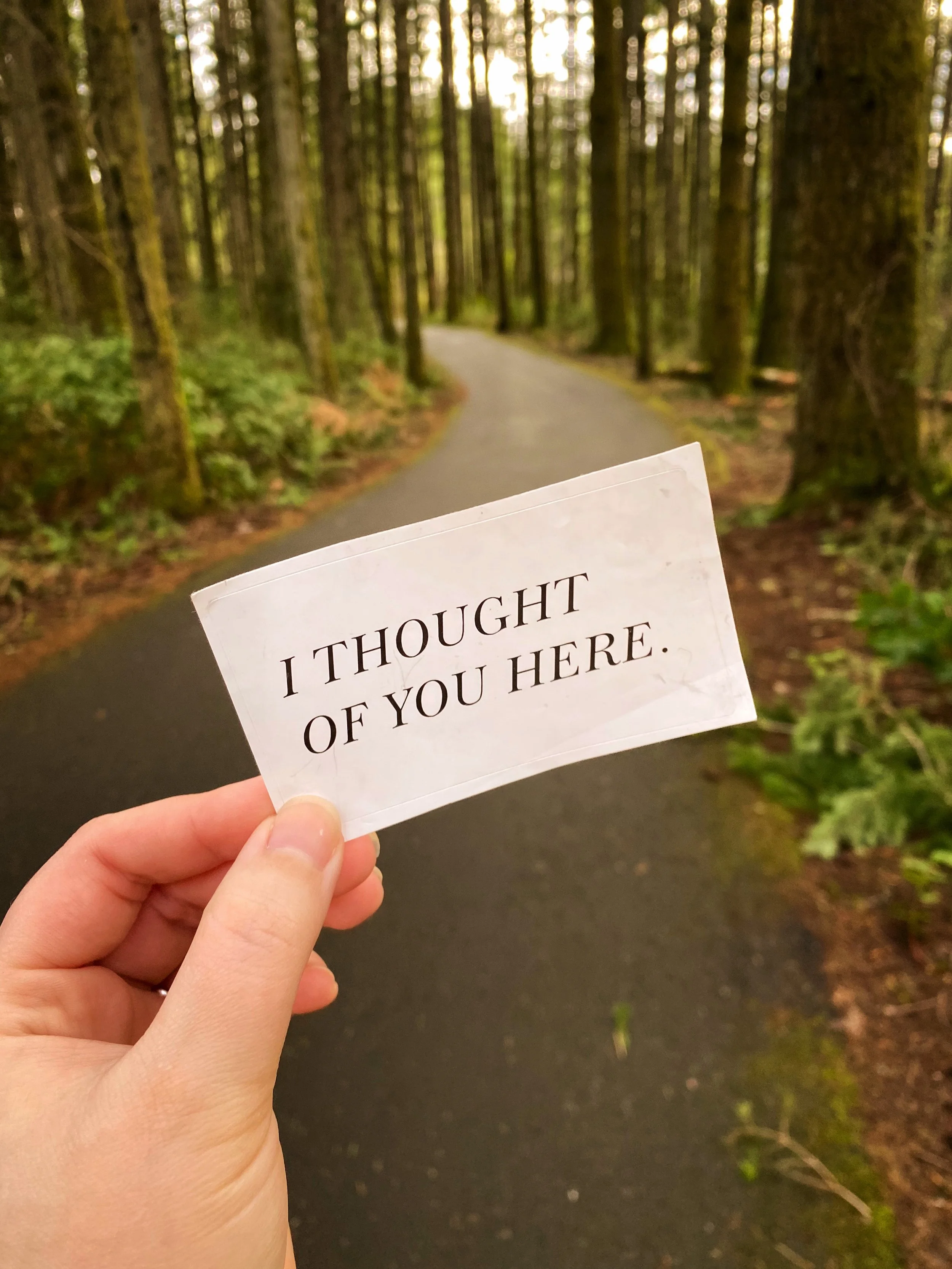
2018 was a milestone year, one that saw me reinforcing my commitment to the future—a future that was largely a blank page in my mind. This was three years after my mom’s death, and I was confronting the existential crisis that had risen up for me out of that death.
That year brought all my loved ones together in ceremony, and within that fullness was an absence. Those who could not be there, had chosen not to be there, or those I didn’t want there. My mom, childhood friends who grew in other directions, past versions of me I felt I had to disown in order to survive.
I began writing the phrase ‘I thought of you here’ on slips of paper, snapping photos of them in the places I visited, sometimes leaving sticker versions behind (sorry, Earth. I don’t do this part anymore).
I didn’t anticipate that I’d still be doing this grief ritual to this day. But, of course, I still visit places that make me think of my departed. I still have experiences that remind me of the living with whom my relationships have ended. My mind continues to have conversations with people I cannot talk with. Ordinary remembering falls short, and it still means something that these photos make my thoughts tangible.
Thoughts, feelings and sensations are internal, private and insulated without expression. Even in acute grief, when it feels for most of us as though we have been stripped bare and exposed on a grand stage, this is merely a feeling and not reality. That which cannot be seen can still mark you. It can harm. It can soothe and even save. Thoughts, some of which are empty and meaningless noise, have the power to influence decisions, shape perspectives, and alter a person’s path in life. The photo is representation of something that occurs invisibly.
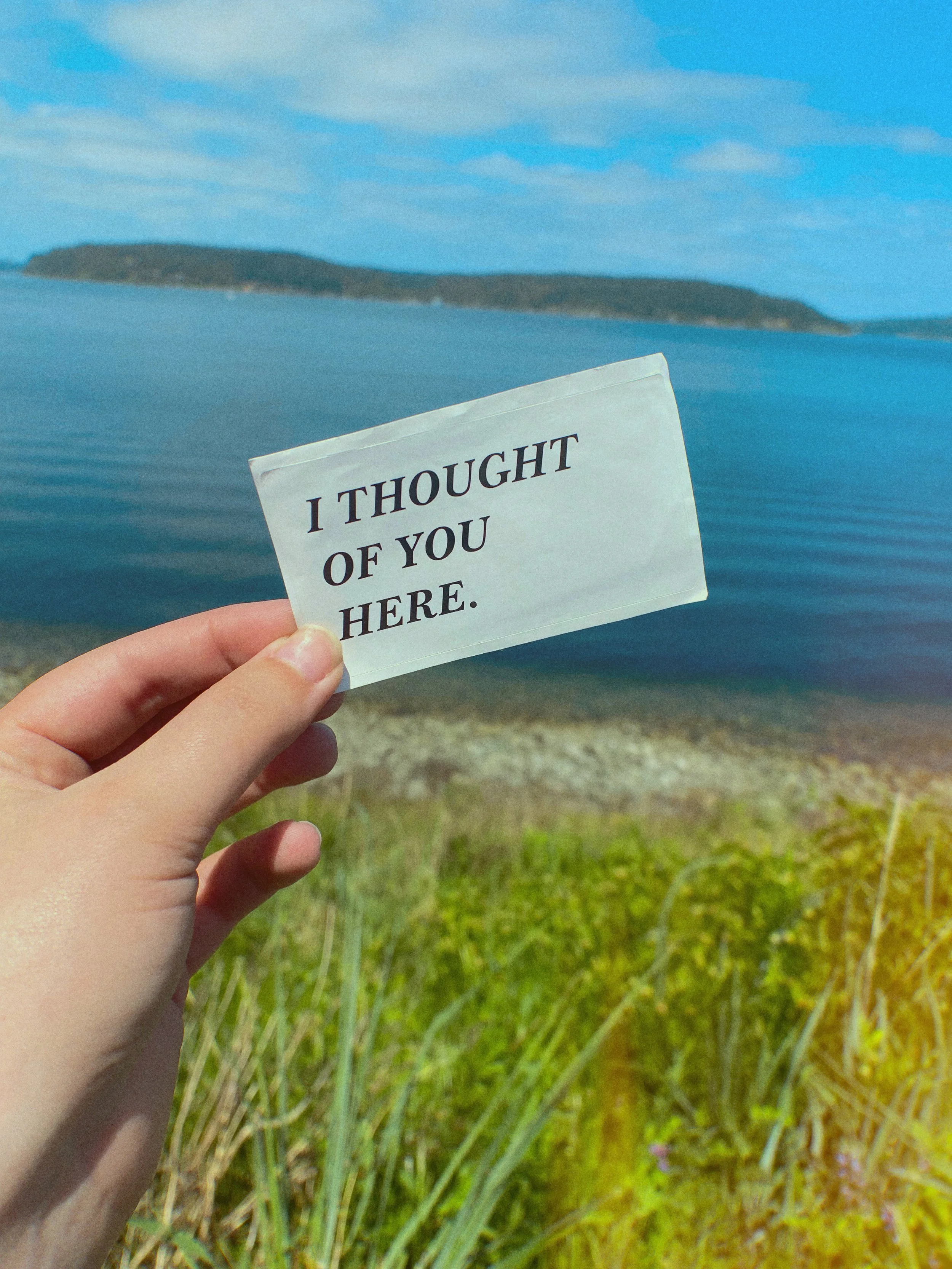
Even I am surprised by the particular person conjured by certain landscapes, culturally-charged monuments, and liminal spaces. That it is not always the dead. Place is linked with people; it becomes exhibition of relationship. Everywhere I go (and everywhere I went before I started this memorialization project) is populated by the people I carry. If you have ever known love, sustained or severed, you never travel alone. You bring your ghosts wherever you are.
Stephen Jenkinson, referring to folks carrying out the duty of dying, writes: "My experience tells me that most people fear disappearing, fear what their families and friends and rest of us are going to do with them after they die, fear our well-known ability to get on with our lives. They are afraid of the surface of life closing over their heads, slipping beneath the waves and disappearing from view and from mind and from life itself. That is the death they fear, in my experience.”
No matter the complications of the relationships I have with those who have died, I will not allow those I love to succumb to a second death by forgetting them. Amnesia, for all it may do in measures for coping, is not a healing practice. Those I’ve lost have not been simply exorcised from my body. They live there still, but only I can know.
There is healing in this even for those I wish I could release and never think of again. Some of the deepest grief involves the living, as well as those I am glad are gone. Yet, my thinking of them operates largely outside my realm of control. By acknowledging when my ghosts are with me, begrudgingly I honor whatever longing, regret, or nostalgia accompanies the memory. When room is offered for pain, then gratitude, too, can arrive. Some of my worst memories are my life’s teachings.
“…that remembering means gathering back together again something that was once whole and has been scattered,” writes Jenkinson, “and that the human heart was built to break, and that feeling that heartbreak each time is remembering again the deep things of life that need remembering.”
I pull out the slip of paper, I take the photo that contains my remembering, and then I put it away. I lift my eyes back to the horizon.
I do not “move on” but I do keep adventuring. My heart stays a little broken because it leaves an opening. This is a skill. As Josh Kilmer-Purcell says, “holding onto someone is not the same as keeping them close,” which, to me, means that loss must remain part of the story, or else the remembering is more an act of fear than one of love.
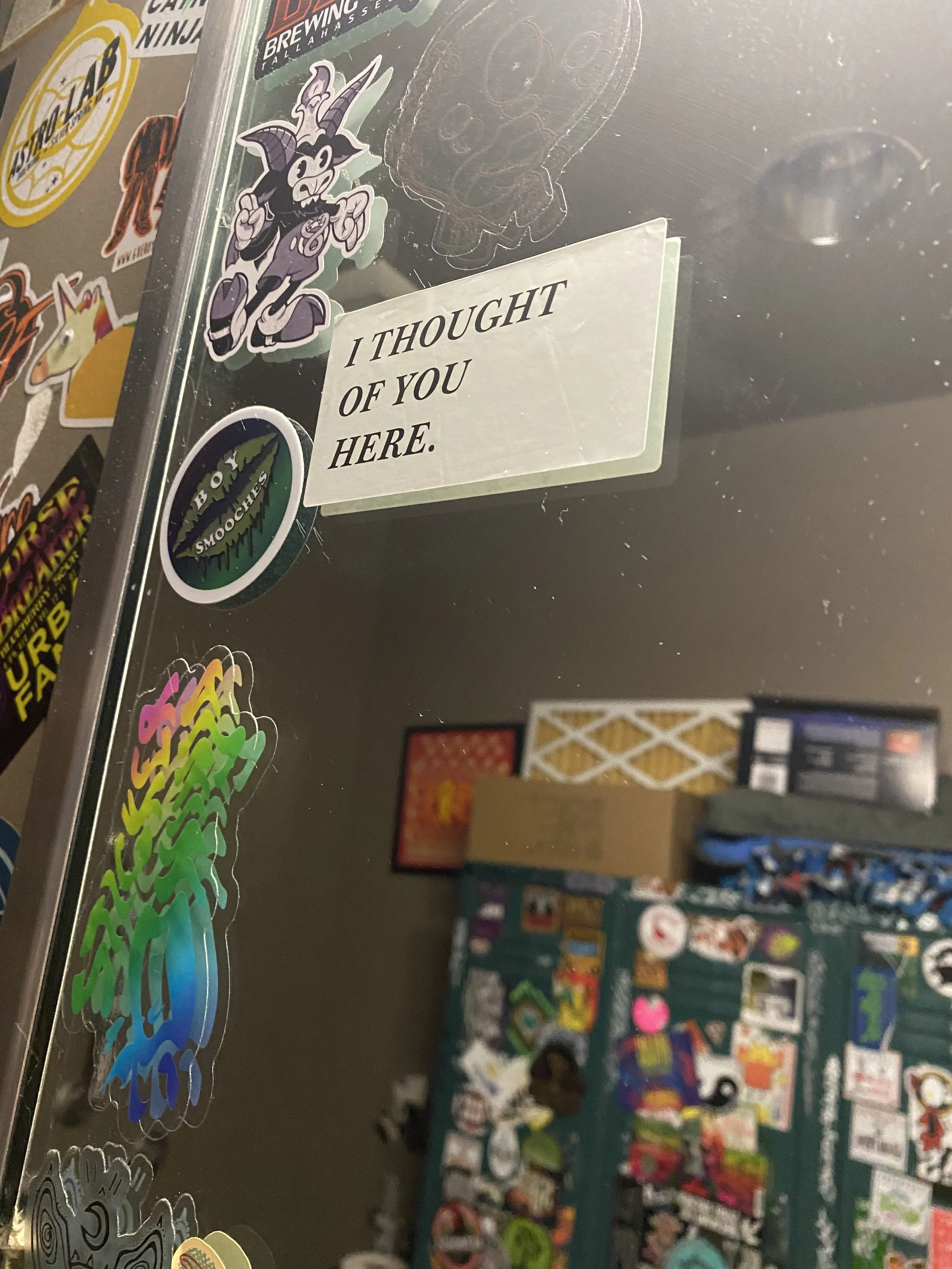
I’ve noticed, in the accumulation of this eight-year practice, that the photos have become joyful and less afraid. What was born in a tone of stark desperation has grown more free and vivid. I believe when I started, I was a seeker. I craved connection, witnessing, and confirmation that the people who were gone from me weren’t gone entirely, and that my thoughts of them mattered. I wanted those thoughts to land somewhere real.
I need that less now and I do this more for me than I used to. For me, and for other grievers. There are times when a stranger will reach out to me with their own I-thought-of-you-here moment, then the person they are thinking of becomes tangible to me and I can think of their loved one, too.
When our people leave, our relationships with them do not disappear. We don’t get to make everyone stay, but we do get choices in how to keep them close. If, or when, I let this ritual go, I will lose a witness but nothing else. My ghosts, living and dead, still go where I go. I will still think of them.