
The Sum Of All Longing
I’ll try not to, but I could write a thousand entries about unlived lives. The call of my own unlived lives arise in the quiet moments of my life, and it echoes constantly in my work. The notion exists in the questions people bring to me, and the stories they tell: what could have been, what should have been, what almost was, what cannot be, what gets lost when becoming another. It is grief, yes, but it is guidance, too. Unlived lives hold meaning, if we are courageous enough to go digging in the ruins.
When people share their pasts, they are often offering me the outlines of lives that didn’t unfold. A dream set aside. A path not taken. A version of themselves that never got to fully breathe, or even be conceived because life demanded something else. Unlived lives result from trauma and pain, from loss, from societal pressure and expectations, oppression, marginalization, mere influence. Choices that weren’t right or wrong, just a turn in one direction instead of another. They result from the good stuff, too, like being presented with multiple great options, having a child, entering a relationship, moving somewhere for a job, happy surprises.
Life lurches. As is its way.
In its wake: longing, fear, regret, distrust. Often it is not regret itself that aches the most, but the denial of regret. The looming threat of lost potential is a paralyzing sedative. We want so badly to make the “right” choice, to avoid disappointing ourselves or others. In this anxious landscape, many struggle to discern which voice inside is telling the truth.
This is where it becomes entangled with the challenge of knowing which inner signals to trust. Differentiating a gut feeling from anxiety, trauma response, or compulsion is really damn difficult. The mind can easily override the body in the name of safety or sense-making. With me, it so often comes back to this: it’s not about finding the correct answers, but asking fruitful questions.
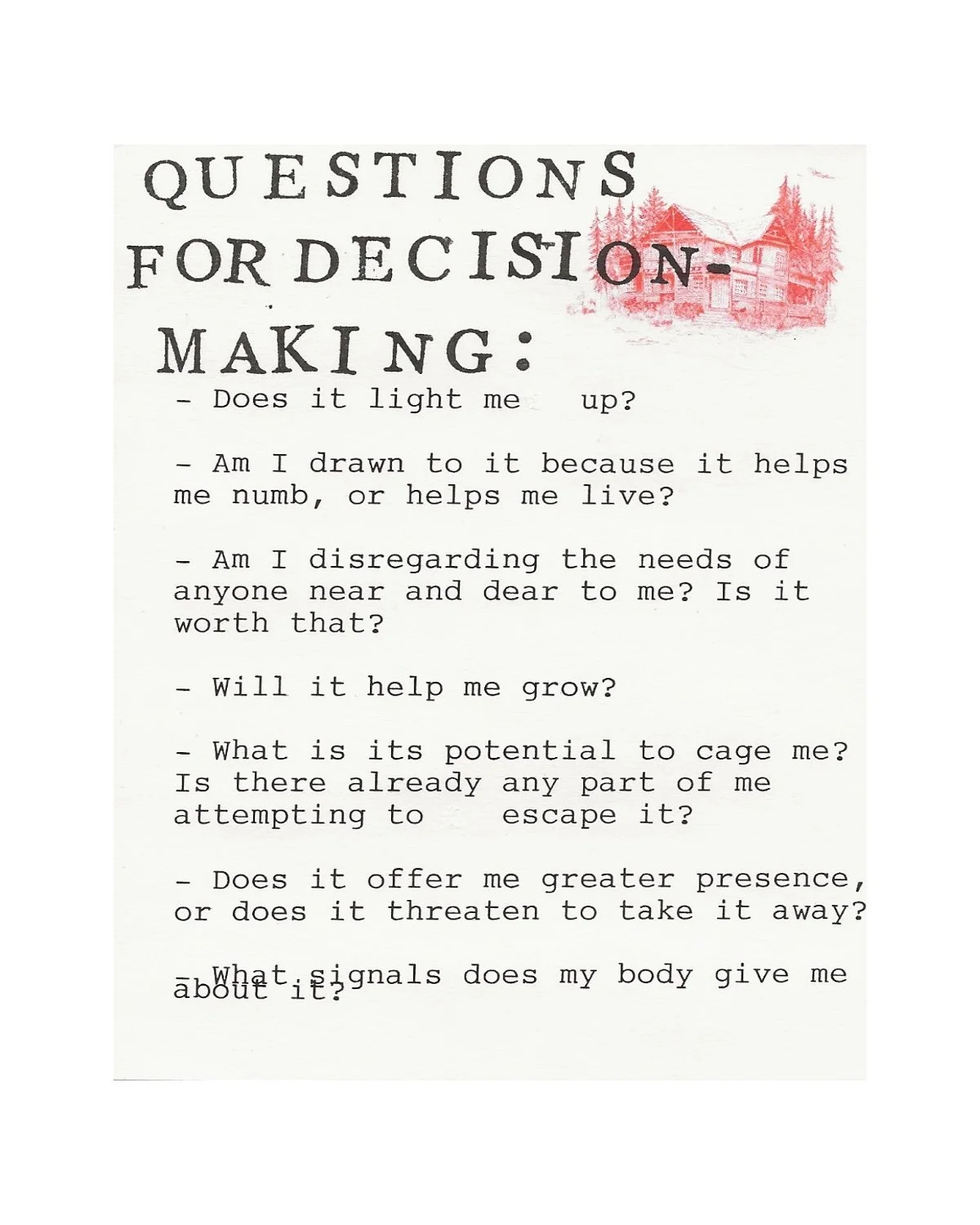
Trauma, anxiety, and habit can all mimic intuition. These things are protective and powerful, and sometimes even dynamic. While their guidance may not always point toward growth, they still offer information. A panicked “no” can be a form of care. It may be shielding something vulnerable or sacred. The question is not, “Is this real?” but “What is this trying to protect?”.
Am I reacting from a part of me that remembers something old?
Return to regret, often shunned or silenced. We don’t like its company, but it is just a feeling. Natural. Persistent. Capable of offering wisdom when we ask it what it knows.
Am I needlessly sacrificing alignment for the sake of safety and comfort? If so, is this something I forgive myself for?
Writing is one way we can begin to parse these signals. In a poem, a person can walk down the path of an unlived life. Through a few lines, they can try on another version of themselves, without cost or consequence. Free-writing can make space for inner conflict. Writing can help us name the parts that want different things. The writing reveals not just a choice, but a deeper truth: that some inner conflicts are not meant to be solved, but witnessed. Sometimes its less about exploring options and more about telling the truth.
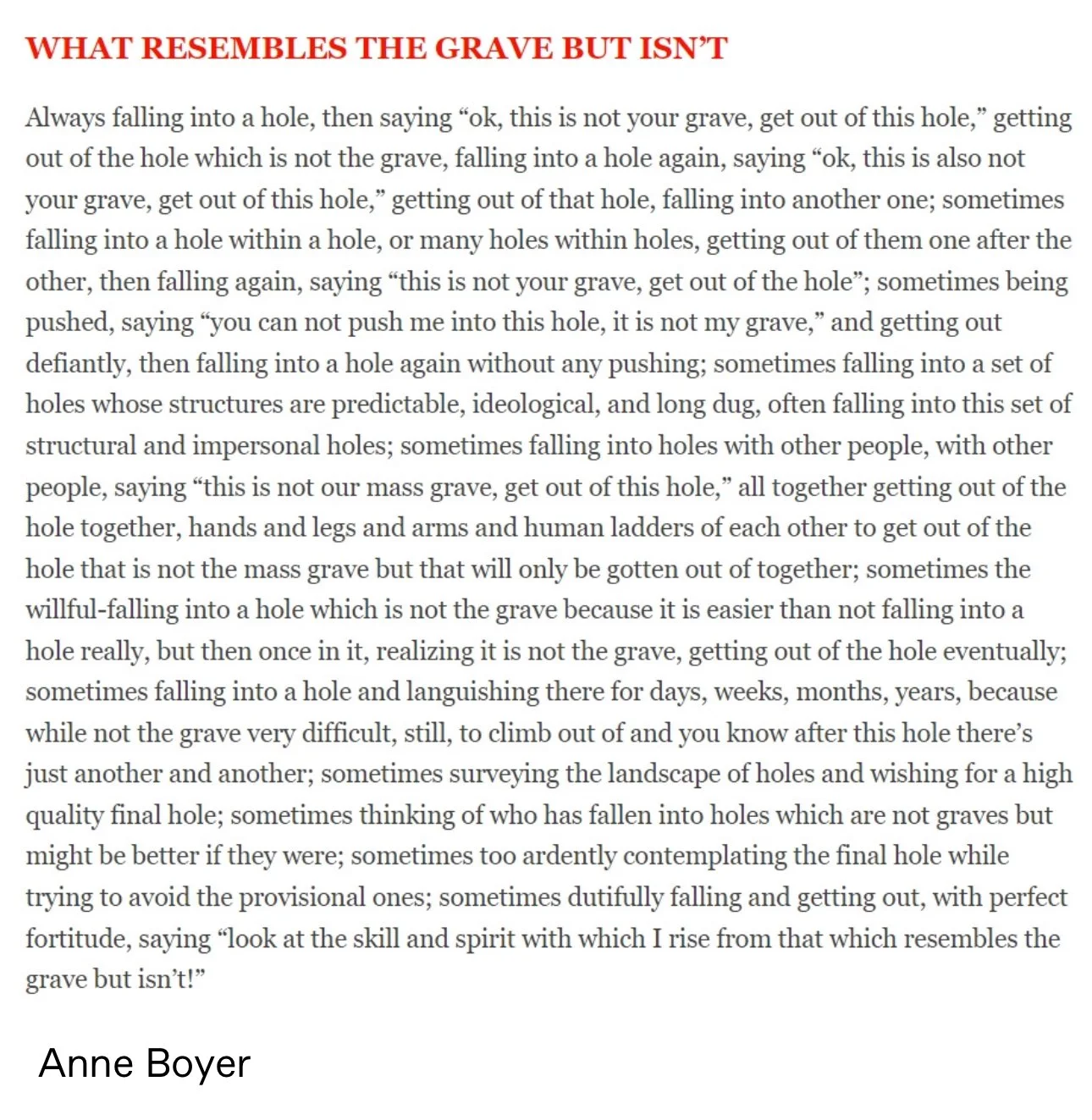
I’ve been contemplating Anne Boyer’s What Resembles the Grave But Isn’t, which speaks to the repetitive nature of survival. Those of us who have to fight for our lives rarely ever have to do so only once. We survive again and again and again. I think about the unwritten future of this poem, the way our protective parts continue to see graves everywhere and try desperately to steer us away. How often we mistake possibility for doom, how much life we lose trying not to lose any more. How much sense that can make for those who have lost so much already, yet too often becoming a feedback loop… and after this hole you know there’s just another and another.
Unlived lives are not waste. They are not ghosts we must exorcise to be free. They are part of us, evidence of our capacity to dream, to imagine, to want. These lives we did not live still shape the one we did. They don’t have to disappear for us to move forward. We can carry them with us, informing our decisions, offering alternate perspectives, feeding the multitudes we contain.
We do not have to disown the parts of us that yearned for something else. Maybe it is not about choosing one dream and cutting the others away, but holding them all lightly, and looking at the possibility that exists there with an artist’s eye. Maybe it’s about becoming a bigger container. So, we can't live out every version of our imagined life, but we can live in ways that are faithful to the dreams behind those lives. A life of teaching also contains performance. A life of caregiving can also contain solitude. A life rooted in responsibility can still stretch toward wildness and self-devotion.
We can still live many lives within one life. And sometimes, what keeps us from doing so is a sense of loyalty. Loyalty to a false sense of consistency, to outdated versions of who we were or were supposed to be. We feel obligated to be reliable, to remain unchanged, to be legible to those around us. What would it be like if we were more devoted to our cyclical natures than to fidelity?
Change is inevitable, but it is also possible. Not because it will be summoned like magic (though, sometimes, yeah, that’s how it happens), but because you are still here, still choosing. The tools of transformation are not far-off or esoteric. They are your longings. Your questions. Your sadness. Your restlessness. These are signals. Invitations.
Our intuitive knowing, our past selves who are hurting, our future selves who are afraid or regretful, our never-selves we mourn for, are not separate. They exist along the same thread. They all speak to how we make meaning out of choice, out of fear, out of time. They speak to how we hold all of our stories (those carried out and never begun), and how we might begin to listen to our multitudes with more clarity.
We are never really stuck. We are the guide and we are the follower. Our internal protectors, while sometimes confused, are trying to help get out, and stay out, of the hole.
Our values are here, too. The people we love. The creativity and awful beauty of life, offering itself to us again and again.